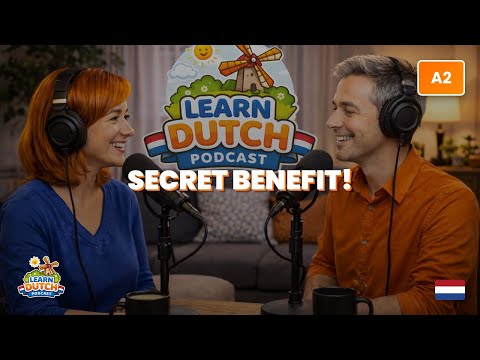
Anita and Henk show why fluency requires effort, using a bakker, coffee chat, and train commute to explain realistic habits, practice types, and expectations.
Wist je dat veel mensen denken dat je met één app na drie maanden gewoon vloeiend bent?
Did you know that many people think you can just be fluent after three months with one app?
Echt, ik hoor dat zo vaak in de les.
Seriously, I hear that so often in class.
En ja, daarna zijn ze teleurgesteld, want het gaat niet zo snel, hoor.
And yes, then they're disappointed because it doesn't happen that fast, you know.
Ja, en nog zoiets. Mensen zijn vaak dat taalleren makkelijk is als je slim bent.
Yeah, and another thing. People often think learning a language is easy if you're smart.
Nou, dat is dus een mythe, een soort verhaal dat niet klopt.
Well, that's a myth, a sort of story that isn't true.
Het kost tijd, aandacht en ook een beetje lef.
It takes time, attention, and a bit of courage too.
Laat ik het meteen even prikkelend maken. Als het zo makkelijk is, waarom stoppen dan zoveel mensen na zes weken?
Let me make it provocative right away. If it's that easy, why do so many people quit after six weeks?
Het echte probleem is niet de taal, maar de verwachting.
The real problem isn't the language, but the expectation.
Oké, laten we even normaal beginnen, haha.
Okay, let's start normal, haha.
Hoi allemaal, leuk dat jullie luisteren.
Hi everyone, great that you're listening.
Ik ben Anita en ik zit hier weer met Henk, met koffie en met, uh, best veel meningen.
I'm Anita, and I'm here again with Henk, with coffee and, uh, quite a few opinions.
Hoi, hoi. Fijn dat je er bent.
Hi, hi. Nice to have you here.
Vandaag praten we over die mythe, een nieuwe taal leren is makkelijk.
Today we're talking about that myth, learning a new language is easy.
Nou, nee dus.
Well, no it isn't.
Maar het is wel goed te doen als je het slim en rustig aanpakt.
But it is doable if you approach it wisely and calmly.
Ja, precies.
Yes, exactly.
We willen je vandaag helpen met realistische tips, kleine stapjes en ook wat verhalen.
We want to help you today with realistic tips, small steps, and also some stories.
En we doen een korte roleplay, zodat je meteen kunt horen hoe je in het echt iets kunt zeggen, ook als je nog niet alles weet.
And we'll do a short roleplay so you can immediately hear how to say something in real life, even if you don't know everything yet.
Eerst even dit misverstand.
First, let's clear up this misunderstanding.
Veel mensen zeggen: jonge mensen leren sneller, oudere mensen hebben pech.
Many people say: young people learn faster, older people are out of luck.
Nou, er is wel verschil, maar oudere mensen hebben ook voordeel.
Well, there is a difference, but older people also have advantages.
Ze hebben strategieën, ze plannen beter en ze kennen al veel woorden uit andere talen.
They have strategies, they plan better, and they already know a lot of words from other languages.
En nog een punt waar mensen boos over kunnen worden.
And another point that can make people upset.
Experts die geen Nederlands leren.
Experts who don't learn Dutch.
Sommigen zeggen: dat is respectloos.
Some say: that's disrespectful.
Anderen zeggen: rustig, het is al veel voor een nieuw leven.
Others say: take it easy, it's already a lot for a new life.
Ik denk: probeer in elk geval iets, een paar zinnen per dag.
I think: at least try something, a few sentences a day.
Dat laat zien dat je moeite doet.
That shows you're making an effort.
Ja, maak het klein en haalbaar.
Yes, keep it small and achievable.
Zeg bij de bakker even goedemorgen en twee broodjes, alstublieft.
Say good morning and two rolls, please, at the bakery.
Dat is geen grote stap, maar het helpt wel.
That's not a big step, but it helps.
En mensen vinden dat leuk, hoor.
And people like that, you know.
Oké, tijd voor die roleplay, vroeg in de aflevering, zoals beloofd.
Okay, time for that roleplay, early in the episode, as promised.
Stel, jij bent in een café en je Nederlands is nog, uh, half.
Imagine you're in a café and your Dutch is still, uh, half.
Wat doe je dan?
What do you do then?
Laten we het spelen.
Let's act it out.
Ik ben de klant.
I'm the customer.
Ik zeg: hallo, uh, goedemiddag.
I say: hello, uh, good afternoon.
Mag ik een koffie, alstublieft?
Can I have a coffee, please?
Dan kijk ik vriendelijk en ik wijs naar de kopjes, gewoon als extra hulp.
Then I smile and point to the cups, just as extra help.
Ik ben de barista.
I'm the barista.
Ik zeg: zeker.
I say: sure.
Welke koffie wil je?
What coffee would you like?
En jij weet het woord niet voor cappuccino.
And you don't know the word for cappuccino.
Wat zeg je dan?
What do you say then?
Dan zeg ik: die met melk en schuim, hoe heet dat?
Then I say: the one with milk and foam, what's that called?
En ik maak zo'n klein melkschuimgebaar met mijn hand.
And I make a little milk foam gesture with my hand.
Dat is non-verbaal, dus zonder woorden, maar het helpt.
That's non-verbal, so without words, but it helps.
Ik zeg dan: ah, een cappuccino.
I then say: ah, a cappuccino.
En jij: ja, cappuccino, dank je wel.
And you: yes, cappuccino, thank you.
Kijk, dit is perfect.
Look, this is perfect.
Niet perfect qua taal, maar perfect qua communicatie.
Not perfect in language, but perfect in communication.
Je gebruikt woorden en gebaren.
You're using words and gestures.
En als ik iets niet versta, dan zeg ik: sorry, wil je het herhalen, alsjeblieft?
And if I don't understand something, I say: sorry, could you repeat that, please?
Of iets langzamer.
Or a bit slower.
Dat is zo krachtig.
That's so powerful.
Je hoeft je niet te schamen, hoor.
You don't need to be ashamed, you know.
Over schaamte gesproken, ik heb een verhaal.
Speaking of shame, I have a story.
Een cursist wilde zeggen: ik hou van het weer.
A student wanted to say: I love the weather.
Maar hij zei per ongeluk: ik hou van je moeder.
But he accidentally said: I love your mother.
Iedereen moest lachen, ook de mevrouw.
Everyone laughed, even the lady.
En weet je, daarna hadden ze juist een leuk gesprek.
And you know, afterwards they actually had a nice conversation.
Ja, geweldig.
Yes, great.
Fouten maken is niet fijn, maar het maakt je menselijk.
Making mistakes isn't fun, but it makes you human.
En soms is het zelfs een ijsbreker.
And sometimes it's even an icebreaker.
Dus echt, omarm die imperfectie.
So really, embrace that imperfection.
Je leert er sneller door.
You learn faster that way.
Wat ook lastig is: mensen verwachten snelle winst.
What's also tough: people expect quick wins.
Zo van: ik doe een challenge van dertig dagen en dan ben ik klaar.
Like: I’m doing a thirty-day challenge and then I’m done.
Maar taal is geen sprint, het is meer een wandeling.
But language isn’t a sprint, it’s more of a walk.
Elke dag een stukje en soms ga je even traag.
A little bit every day, and sometimes you go a bit slow.
En dan komt het woord plateau.
And then comes the word plateau.
Dat is een moment dat je niet vooruit lijkt te gaan.
That's a moment when you don’t seem to be making progress.
Je voelt: ik leer niks nieuws.
You feel: I'm not learning anything new.
Maar meestal leer je wel, alleen zie je het nog niet.
But usually, you are, you just don't see it yet.
Je brein is aan het opruimen en verbinden, zeg maar.
Your brain is sorting and connecting, so to speak.
Tipje voor zo'n plateau.
A tip for such a plateau.
Wissel even van activiteit.
Switch activities for a bit.
Ga een kort podcastje luisteren of praat twee minuten met de buurman of lees een simpel recept.
Listen to a short podcast or chat for two minutes with the neighbor or read a simple recipe.
Verander het ritme, maar ga niet stoppen.
Change the rhythm, but don’t stop.
Ja, en leg de lat lager.
Yes, and lower the bar.
Zeg niet: vandaag leer ik twintig woorden.
Don’t say: today I'll learn twenty words.
Zeg: vandaag leer ik drie woorden en gebruik ik ze in zinnen.
Say: today I’ll learn three words and use them in sentences.
Dat voelt haalbaar en je onthoudt het beter.
That feels achievable and you remember it better.
Nog even over die discussie met expats.
A little more about that discussion with expats.
Ik snap beide kanten.
I understand both sides.
Als je hier komt wonen, probeer dan de basis te leren.
If you move here, try to learn the basics.
En als je Nederlander bent, heb wat geduld met beginners.
And if you're Dutch, be patient with beginners.
Een glimlach helpt meer dan kritiek.
A smile helps more than criticism.
Oké, we zitten wel lekker op gang.
Okay, we’re off to a good start.
Zullen we even een mini-quiz doen voor de luisteraar en voor jou, Henk?
Shall we do a mini-quiz for the listeners and for you, Henk?
Even testen.
Just testing.
Kom maar op, ik ben er klaar voor.
Bring it on, I'm ready.
Leuk, denk ik.
Sounds fun, I think.
Vraag 1: Wat betekent mythe ook alweer?
Question 1: What does myth mean again?
Niet het dier, hè? Dat is een mythisch beest.
Not the animal, right? That’s a mythical beast.
Ik bedoel hier het woord in ons onderwerp.
I mean the word in our context.
Een mythe is een verhaal dat veel mensen geloven, maar dat niet echt klopt.
A myth is a story that many people believe, but that isn’t really true.
Zoals: taalleren is makkelijk en snel.
Like: learning a language is easy and quick.
Nou, mooi niet.
Well, not really.
Yes, precies.
Yes, exactly.
En vraag 2: Wat was plateau?
And question 2: What was plateau?
Dat moment dat je het idee hebt dat je niet vooruitgaat.
That moment when you feel like you’re not making progress.
Antwoord: je gaat vaak wel vooruit, maar je ziet het nog niet meteen.
Answer: you are often making progress, but you can’t see it right away.
Mooi, recap gedaan.
Nice, recap done.
Laten we verder met concrete tips, want daar heb je wat aan.
Let’s move on to concrete tips, because those are helpful.
Eerste tip.
First tip.
Maak vaste momenten.
Set fixed times.
Bijvoorbeeld na het ontbijt 5 minuten luisteren en 5 minuten hardop nazeggen.
For example, listen for 5 minutes after breakfast and repeat out loud for 5 minutes.
Klinkt klein, werkt groot.
Sounds small, works big.
Tweede tip.
Second tip.
Spreek sneller dan je comfortabel vindt.
Speak faster than you’re comfortable with.
Niet rammen, maar wel praten.
Don’t rush, but do talk.
Zeg het fout, verbeter jezelf en ga door.
Say it wrong, correct yourself, and keep going.
Stilte leert je niets, praten wel.
Silence teaches you nothing, talking does.
Gebruik non-verbale trucs.
Use non-verbal tricks.
Wijs, teken in de lucht, tel op je vingers, trek een gezicht dat past bij het woord.
Point, draw in the air, count on your fingers, make a face that matches the word.
Mensen begrijpen je dan sneller en jij voelt minder druk.
People will understand you faster and you’ll feel less pressure.
Vierde tip.
Fourth tip.
Leer een paar zinnen voor nood.
Learn a few emergency phrases.
Bijvoorbeeld: hoe zeg je in het Nederlands en kan je dat herhalen, alsjeblieft? en ik begrijp het niet helemaal.
For example: how do you say in Dutch and can you repeat that, please? and I don’t quite understand.
Met die zinnen red je je in veel situaties.
With those phrases, you can manage in many situations.
En nu een veelgemaakte fout.
And now a common mistake.
Wachten tot je uitspraak perfect is.
Waiting until your pronunciation is perfect.
Doe dat niet.
Don’t do that.
Je uitspraak wordt beter door te praten, niet door te wachten.
Your pronunciation improves by speaking, not by waiting.
Natives waarderen je poging.
Natives appreciate your effort.
Ik heb nog een verhaal over uitdrukkingen.
I have another story about expressions.
Een leerling voerde eindelijk een vlotte chat met een buurman.
A student finally had a smooth chat with a neighbor.
Top, dacht hij.
Great, he thought.
Later snapte hij dat ze het helemaal niet over sport hadden, maar over geldzaken.
Later he realized they weren’t talking about sports at all, but about finances.
Hij kende de uitdrukking niet en miste zo de clue.
He didn’t know the expression and missed the point.
Ja, idiomen zijn tricky.
Yes, idioms are tricky.
Neem als voorbeeld: het regent pijpenstelen.
Take for example: it’s raining cats and dogs.
Dat betekent: het regent heel hard.
That means: it’s raining very hard.
Geen echte pijpen, hè?
No real cats, right?
Als je zoiets hoort, vraag gewoon: wat betekent dat?
When you hear something like that, just ask: what does that mean?
Mensen leggen het vaak graag uit.
People often like to explain it.
Zullen we een mini-roleplay doen met een uitdrukking?
Shall we do a mini-roleplay with an expression?
Kort en simpel.
Short and simple.
Ik ben de buurvrouw.
I’m the neighbor.
Ik zeg: zo, jij gaat als een speer op je Nederlands.
I say: wow, you’re really getting the hang of your Dutch.
Ik ben de leerling.
I’m the student.
Ik zeg: wat betekent als een speer?
I say: what does like a spear mean?
En dan lach ik even en ik knik, zodat het luchtig blijft.
And then I laugh a little and nod, to keep it light.
Ik zeg: dat je snel gaat.
I say: that you’re going quickly.
En jij zegt: ah, dank je.
And you say: ah, thank you.
Ik probeer elke dag een beetje.
I try a bit every day.
Vriendelijk, duidelijk en jij hebt weer een uitdrukking geleerd.
Friendly, clear, and you've learned another expression.
Nog eentje over leeftijd, want die discussie komt vaak terug.
One more about age, since that discussion often comes up.
Ja, een kind pikt klanken sneller op, dat klopt wel.
Yes, a child picks up sounds faster, that's true.
Maar volwassenen kunnen doelen stellen, snappen grammatica sneller en hebben discipline.
But adults can set goals, understand grammar quickly, and have discipline.
Je kunt dus op elke leeftijd goed leren met de juiste aanpak.
So you can learn well at any age with the right approach.
En je hoeft niet alles tegelijk te doen.
And you don't have to do everything at once.
Kies per week een thema.
Choose a theme each week.
Bijvoorbeeld: boodschappen, reizen met de trein of een doktersafspraak.
For example: groceries, traveling by train, or a doctor's appointment.
Leer de belangrijkste tien zinnen en gebruik ze dan meteen in het echt.
Learn the ten most important sentences and use them immediately in real life.
Over de trein gesproken: oefenzinnen die je straks nodig hebt.
Speaking of trains: practice sentences you'll need later.
Zoals: mag ik een retour naar Utrecht?
Like: can I get a return ticket to Utrecht?
Of: komt deze trein op tijd?
Or: is this train on time?
Als je dat tien keer zachtjes oefent, rolt het straks vanzelf uit je mond.
If you practice that softly ten times, it'll roll off your tongue naturally.
En vergeet luisteren niet.
And don't forget to listen.
Zet een kinderprogramma op of een korte video met ondertitels.
Put on a children's program or a short video with subtitles.
Luister eerst mee, lees mee en dan nog een keer alleen luisteren.
First, listen along, read along, and then listen alone again.
Je oren moeten ook trainen, net als spieren.
Your ears need to train too, just like muscles.
Ook handig: praat tegen jezelf.
Also helpful: talk to yourself.
Echt, ik doe dat ook.
Really, I do that too.
Ik ga nu koken.
I'm going to cook now.
Eerst snijd ik de ui.
First, I’ll chop the onion.
Daarna, eh, waar is het mes?
Then, uh, where's the knife?
Het klinkt gek, maar je maakt zinnen automatisch.
It sounds silly, but you create sentences automatically.
En stuur spraakberichtjes naar een taalmaatje.
And send voice messages to a language buddy.
Dertig seconden is genoeg.
Thirty seconds is enough.
Je hoort jezelf terug en je leert van kleine foutjes.
You hear yourself back and learn from small mistakes.
Plus, het is minder eng dan live praten in het begin.
Plus, it’s less scary than speaking live at first.
Wat doe je als iemand naar het Engels switcht?
What do you do if someone switches to English?
Blijf vriendelijk en zeg: mag ik het in het Nederlands proberen?
Stay friendly and say: can I try it in Dutch?
Meestal zegt de ander: tuurlijk.
Usually, the other person says: of course.
En dan kun je verder.
And then you can continue.
Als het echt niet gaat, geen stress.
If it really doesn't work, no stress.
Morgen weer een kans.
Tomorrow is another chance.
En wees eerlijk tegen jezelf.
And be honest with yourself.
Oké, samenvatten in drie punten.
Okay, summarize in three points.
Mag ik nog een mini-lijstje met zinnetjes voor beginners?
Can I have another mini-list of sentences for beginners?
En een tip voor gebaren: wees vriendelijk met je gezicht.
And a tip for gestures: be friendly with your face.
Lach, knik, wijs rustig.
Smile, nod, point calmly.
Mensen voelen dan dat je wil leren.
People will feel that you want to learn.
Dat opent deuren, zelfs als je woord even weg is.
That opens doors, even if your word disappears for a moment.
Nog een misverstand.
Another misunderstanding.
Je hebt een perfecte methode nodig.
You need a perfect method.
Elke methode kan werken, als jij hem blijft doen.
Any method can work if you keep using it.
Kies iets dat bij je past en maak het leuk.
Choose something that suits you and make it fun.
En wissel passief en actief af.
And alternate between passive and active learning.
Luisteren is top, maar daarna moet je praten of schrijven.
Listening is great, but then you need to talk or write.
Een klein berichtje, een kort praatje in de winkel.
A small message, a brief chat in the store.
Dat maakt het verschil.
That makes all the difference.
Oké, we naderen het einde.
Okay, we're nearing the end.
Even een vraag aan jou, luisteraar.
Just a question for you, listener.
Wanneer maakte jij je grappigste fout in het Nederlands?
When did you make your funniest mistake in Dutch?
Of welke uitdrukking snapte je eerst totaal niet en nu wel?
Or which expression did you totally not understand at first but do now?
Vertel het ons.
Let us know.
We zijn benieuwd.
We're curious.
Ja, deel het vooral.
Yes, do share it.
En heb jij een tip om het vol te houden?
And do you have a tip to keep it up?
Bijvoorbeeld jouw ochtendroutine of een zin die je elke dag oefent.
For example, your morning routine or a phrase you practice every day.
Zet het in de reacties, dan leren we van elkaar.
Put it in the comments, and we'll learn from each other.
Dank je wel voor het luisteren.
Thank you for listening.
Blijf vriendelijk voor jezelf, praat gewoon en bouw rustig verder.
Be kind to yourself, just talk and keep building slowly.
Tot de volgende keer en succes vandaag met jouw drie nieuwe zinnen.
Until next time, and good luck today with your three new sentences.
Doeg, doeg.
Bye, bye.
En onthoud.
And remember.
Langzaam is ook vooruit.
Slowly is still progress.